A Thousand True Fans Is Worth More Than a Million Strangers
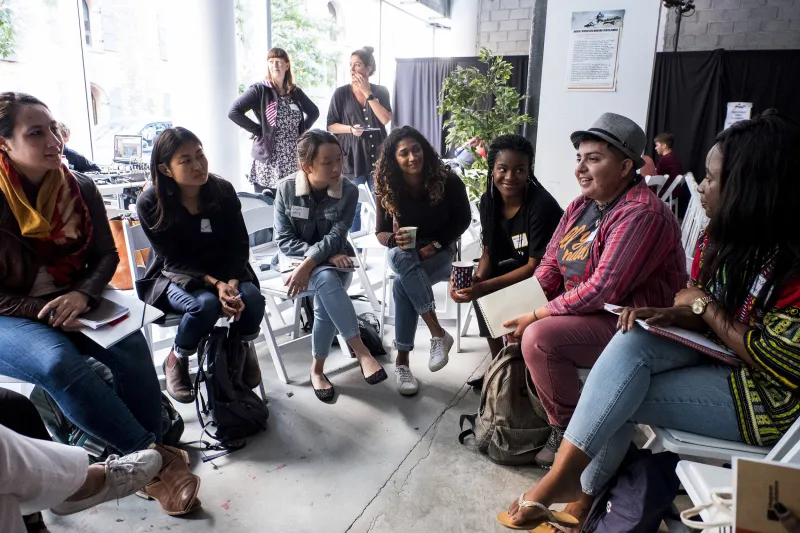
Photo: small intimate community gathering creative workshop engaged people, via images.squarespace-cdn.com
Let's say you have 800,000 followers on Instagram. Sounds incredible, right? Now let's say 790,000 of those people wouldn't notice if you disappeared tomorrow. They double-tapped a photo once, the algorithm served you up, and now you're just part of the noise in their feed. You're famous to people who don't particularly care about you.
Now imagine a different scenario. You have 4,000 subscribers on a niche newsletter about, say, vintage Japanese denim. Every single one of those people opened your last email. Half of them replied. When you dropped a limited merch collab last fall, it sold out in six hours — not because of hype, but because your readers trust you completely and genuinely wanted what you made. You know some of their names. A few of them have become friends.
Which creator would you rather be?
The Numbers Game Is Rigged
The creator economy spent years telling people that reach was everything. More followers, more views, more impressions — scale was the goal, and scale was how you proved your worth to brands, to platforms, to yourself. And to be fair, that logic made sense when advertising revenue was the primary business model. Eyeballs equaled dollars.
But the economics have quietly shifted, and the creators who noticed first are now way ahead. The rise of direct monetization — Patreon, Substack, paid communities, merchandise, digital products, coaching, memberships — changed the math entirely. Suddenly, depth of relationship became more valuable than width of reach. A creator with 5,000 people who will genuinely pay for what they make can outperform one with 500,000 casual followers who won't spend a dime.
Kevin Kelly's old idea of "1,000 True Fans" — the theory that any creator who cultivates a thousand people willing to spend $100 a year on their work can make a living — has gone from interesting thought experiment to practical blueprint. A lot of creators are living it right now.
What a Real Fan Actually Looks Like
The word "fan" has a lot of baggage. It conjures screaming crowds, parasocial obsession, maybe a little bit of chaos. But the kind of fan we're talking about here is something different — more like a highly engaged community member than a celebrity worshipper.
Real fans in the creator economy show up consistently. They don't just consume — they participate. They share your work without being asked. They defend you in comment sections. They bring their friends. When you launch something new, they're the first to try it and the first to give you honest feedback. And crucially, they feel a genuine connection to you — your perspective, your taste, your way of seeing the world — not just the content you produce.
Building that kind of relationship takes time and a specific kind of intentionality. It requires showing up as a person, not a content machine. It means being responsive, being vulnerable sometimes, being genuinely interested in the people on the other side of the screen. That's more work than posting and ghosting, but the returns are completely different.
Case Studies in Depth Over Breadth
Consider what's happened in the book community on BookTok and Bookstagram. Some of the most commercially successful book influencers have relatively modest follower counts by platform standards — we're talking 50,000 to 150,000, not millions. But their communities are extraordinarily engaged. When they recommend a book, it sells. Publishers know this. Authors know this. The deals those creators are getting are often better than what bigger but blander accounts can command, because the trust is real and the conversion is measurable.
Or look at what's happening in the gaming space, where streamers on Twitch have figured out that a loyal community of a few thousand regular viewers — people who subscribe, donate, show up every stream, participate in Discord — can generate more stable income than occasional viral moments that bring in a wave of one-time visitors who never come back.
Same pattern in the fitness world, the culinary world, the art world. The creators who are most financially stable and most creatively fulfilled tend to be the ones who stopped trying to appeal to everyone and got very specific about who they were making things for.
The Counterintuitive Strategy: Go Smaller
Here's the part that feels wrong until it doesn't: the fastest path to a sustainable creator career might be to actively narrow your focus. Not to exclude people, but to get so specific about your perspective and your audience that the right people find you and feel like you made this entirely for them.
That specificity is magnetic. In a content landscape where everything is optimized to be broadly palatable, something that feels genuinely made for you — your particular obsessions, your specific aesthetic, your exact sense of humor — is rare and valuable. It creates loyalty that the algorithm can't manufacture.
The creators who understand this aren't trying to go viral. They're trying to go deep. They're building something that a specific group of people will love completely, rather than something that a massive group of people will scroll past without feeling much of anything.
Fame Was Never the Point
There's a certain kind of freedom that comes with letting go of the fame metric. When you're not optimizing for maximum reach, you can take creative risks. You can make things that are weird or niche or uncommercial. You can say no to brand deals that don't fit. You can actually talk to your community and let their feedback shape what you make next.
The creators who've figured this out tend to describe their work differently than the ones still chasing numbers. They use words like sustainable, meaningful, mine. They're not performing for a faceless mass — they're in an ongoing conversation with people who genuinely care.
A thousand people who really see you will always mean more than a million who don't. The math is different, but so is everything else.