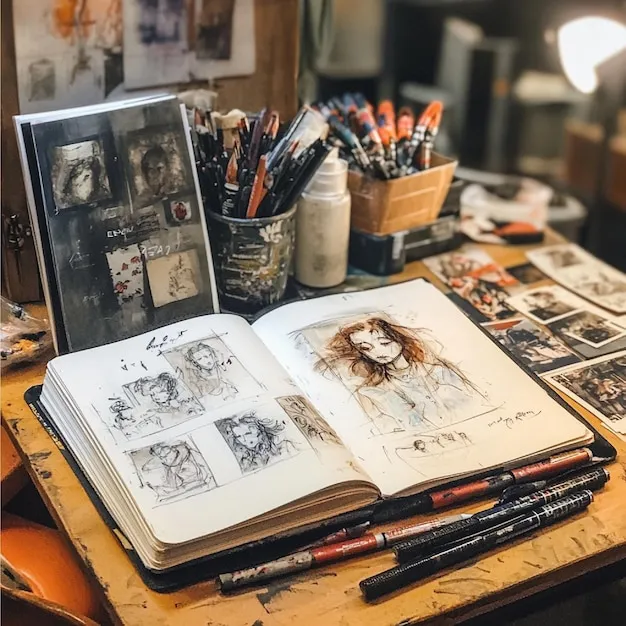
Borrowed Sounds, Original Soul: Why Today's Creators Build Identity From What They Love
Photo: Georges Biard, CC BY-SA 3.0, via Wikimedia Commons
The Sample Is the Sentence
There's a moment in every music nerd's life when they hear a song they grew up loving — and then hear the song inside the song. That dusty James Brown break underneath a 90s rap classic. The Joni Mitchell chord tucked into a Kanye loop. The old Motown bassline resurfacing in something brand new on your Spotify Discover Weekly. Once you hear it, you can't unhear it. And honestly? That's the whole point.
Sampling, interpolation, sonic quotation — call it what you want. For decades, this practice got dismissed as laziness, derivative thinking, or outright stealing. But a growing number of creators are pushing back hard on that framing. To them, building music from existing sounds isn't a shortcut. It's a language. And they've gotten remarkably fluent in it.
Dialogue, Not Derivation
Producer and beatmaker Lena Voss, who's worked with independent artists across Chicago and Atlanta, doesn't use the word "sample" without rolling her eyes at the baggage it carries. "People hear 'sample' and they immediately think you didn't do the work," she says. "But I spend more time digging for the right two seconds of audio than most people spend writing an entire chorus. The curation is the craft."
Voss's production style is built around what she calls "sonic ancestry" — pulling from gospel records, old soul 45s, and obscure library music to construct something that feels both timeless and completely present. Her beats don't sound like the records they're built from. They sound like her. That transformation, she argues, is where the real artistry lives.
This idea — that originality is less about starting from zero and more about what you do with what you inherit — is reshaping how a lot of younger creators think about their own work. Especially in a cultural moment where everything is connected, everything is archived, and everything is technically accessible.
The Remix as Creative Thesis
It's not just producers. Visual artists, writers, filmmakers, and digital creators across every platform are working in this same mode. They're pulling references, remixing aesthetics, and building identities that are explicitly in conversation with what came before. The difference now is that they're not hiding it. They're citing it. Crediting it. Sometimes centering it.
Rapper and producer Milo Cheng, based out of Los Angeles, built his entire debut project around a single era of Hong Kong cinema — specifically the synth-heavy soundtracks from 80s action films his parents used to watch. "I wasn't trying to recreate those films," he explains. "I was trying to figure out what they meant to me now, as someone who grew up here, caught between two worlds. The sounds were a way to have that conversation with my own history."
What Cheng made doesn't sound like an 80s Hong Kong soundtrack. It sounds like someone processing memory through a modern lens — which is exactly what it is. The source material became a mirror, not a blueprint.
When Reference Becomes Voice
There's a craft distinction worth making here. Not every creator who samples or interpolates is doing the same thing. There's a difference between lifting a hook because it works and building a creative identity around the act of dialogue itself. The creators who are genuinely finding their voice through other people's sounds aren't just borrowing — they're responding.
Think about how jazz musicians have always operated. You learn the standards, you internalize the vocabulary, and then you start to bend it, subvert it, push against it. The tradition is the foundation, not the ceiling. Hip-hop has always worked this way too, even when the mainstream gatekeepers refused to recognize it as legitimate musicianship. Now that same logic is spreading across creative disciplines, and younger creators are claiming it without apology.
Singer-songwriter and multi-instrumentalist Deja Okafor puts it plainly: "My whole thing is that I want you to hear where I came from. I want you to recognize the Lauryn Hill in my phrasing, the Nina Simone in my chord choices. That's not a weakness. That's me telling you who shaped me. And then I want you to hear something in there that you've never heard before — something that's only me."
Okafor's recent EP did exactly that. Critics noted the clear lineage. They also noted that nothing sounded like anything else currently out there. Both things were true at the same time.
The Legal and the Ethical Are Different Conversations
It would be dishonest to talk about sampling without acknowledging the complicated legal landscape around it. Clearance culture is real, and it's expensive — a reality that tends to favor major labels and well-resourced artists while making it harder for independent creators to work freely. The Biz Markie case in the early 90s changed the game in ways that still reverberate. The ongoing debates around interpolation rights keep entertainment lawyers very busy.
But the legal question and the creative question aren't the same question. Plenty of creators navigate the legal side through original interpolation — rerecording elements rather than lifting them directly — or by working within the underground and independent spaces where enforcement is looser and community norms around credit matter more than copyright claims.
The ethical dimension, many argue, is actually where the more interesting conversation lives. Who gets credited? Who gets compensated? Whose cultural heritage is being drawn from, and are they benefiting? These are questions that the most thoughtful creators in this space are actively wrestling with — not as abstract philosophy, but as real decisions they make in the studio.
Building Something New From Something Known
Here's what's worth sitting with: in an era of infinite content, infinite access, and infinite noise, the creators who are cutting through aren't always the ones who invented something from nothing. Often, they're the ones who heard something old in a new way — who took a familiar sound and held it up to a different light until it meant something it had never meant before.
That's not a lesser form of creativity. It might actually be one of the harder forms. It requires deep listening, cultural knowledge, genuine taste, and the technical skill to transform rather than just transplant. It requires knowing the difference between homage and imitation, between dialogue and plagiarism.
The Remix Generation isn't running out of ideas. They're proving that ideas were never really the point. The point is what you do with everything you've absorbed — how you metabolize it, transform it, and send it back out into the world with your fingerprints all over it.
That's a voice. And it's entirely their own.