Trash to Treasure: The Creators Who Mine Their Own Failures for Gold
Photo: Silver River Studios, CC0, via Wikimedia Commons
There's a folder on almost every creator's hard drive that nobody talks about. It's got different names — 'old stuff,' 'drafts,' 'don't open this' — but the contents are usually the same: half-finished songs, abandoned visual concepts, video scripts that never made it past page two. Most people treat that folder like a graveyard. A growing number of creators are treating it like a bank account.
Call it creative archaeology. Call it strategic recycling. Whatever you call it, the practice of deliberately looping back through your own rejected work — not out of nostalgia, but with real intention — is producing some of the most interesting output in music, visual art, and digital media right now. And the people doing it have figured out something that sounds almost counterintuitive: your failures often contain more raw material than your successes.
Why the Reject Pile Is More Valuable Than You Think
Here's the thing about a project that didn't work. It didn't fail because it had no ideas — it failed because the execution was off, the timing was wrong, the audience wasn't ready, or you weren't ready. The seed of something real was almost always there. You just couldn't grow it at the time.
When you come back to that material months or years later, you're a different person with different tools. The gap between who you were when you made it and who you are now is exactly where the interesting stuff happens. That distance gives you perspective you simply couldn't have had in the moment.
This is why so many creators who deliberately raid their own archives describe the process as less like recycling and more like translation. You're not just reusing old material — you're reinterpreting it through a new lens. The original idea was a rough draft of something you didn't fully understand yet.
The Music Makers Who Flip Their Own Cuts
In music, this practice has a long, unsung history. Producers and songwriters have always kept stems, loops, and vocal takes that got shelved when a track didn't come together. What's changed is how openly some artists are embracing the process — and how intentionally they're going back in.
There's a pattern you see with certain independent artists who've built serious fanbases without major label infrastructure. They'll release something that gets modest traction, then sit on a version of that song they never released — a rawer take, a different arrangement, a verse that felt too personal at the time. A year later, when they've grown and their audience has grown with them, they revisit that B-side energy and it becomes the thing that resonates hardest.
The technique here isn't just sentimental. It's structural. Some producers literally chop up stems from abandoned projects and rebuild them into entirely new compositions, keeping only the emotional core of the original — a chord progression that felt right even when everything else didn't, a vocal melody that had the right shape but the wrong words. Strip everything else away, rebuild around what actually worked, and suddenly you've got something new that has the weight of lived experience baked into it.
Visual Artists and the Art of the Second Look
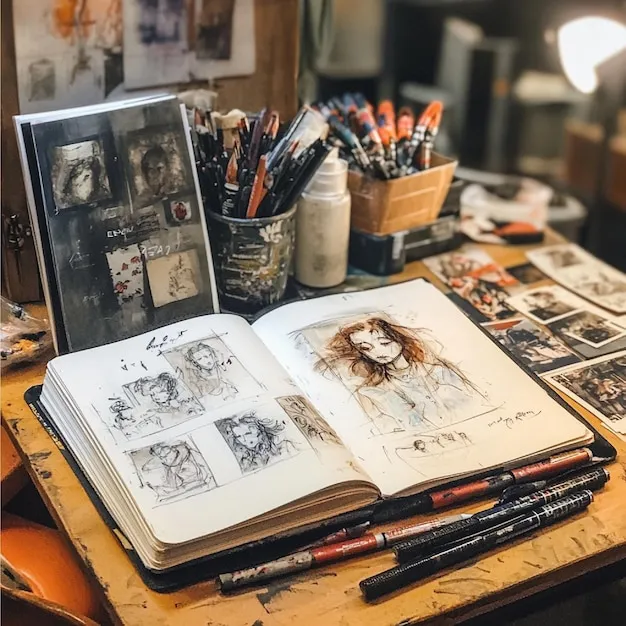
In visual art and design, the rejects-as-resource approach shows up differently but just as powerfully. Digital artists who work in illustration, motion graphics, or experimental visual media often generate enormous amounts of material that never sees a public audience. Concept sketches, color studies, half-rendered scenes — it piles up fast.
Some of the most striking work coming out of independent visual artists right now started as something else entirely. A character design that didn't fit the original project gets pulled out, recontextualized, placed in a completely different world. A color palette that felt wrong for a commercial client becomes the foundation for a personal piece that ends up being the one that goes everywhere online.
What's interesting is that the failure often leaves marks on the material that become its most distinctive features. Something that was 'wrong' for one context — too weird, too dark, too niche — turns out to be exactly right in another. The friction of the original rejection actually preserved qualities that a smoother, more intentional process might have sanded away.
Digital Creators and the Content Compost Heap
For people building audiences on YouTube, TikTok, or podcasting platforms, the archive is often less about polished creative artifacts and more about raw ideas that never made it to production. Scripts that felt too risky. Video concepts that seemed too niche. Podcast episode ideas that got bumped and forgotten.
Creators who've been at it long enough develop a real instinct for which of those shelved ideas were actually ahead of their time versus genuinely not worth pursuing. The ones that felt too niche often become the ones that build the deepest community when they finally get made — because the audience has caught up, or because the creator has found a way to frame the idea that makes it land.
One technique that keeps coming up: some creators keep a running 'cold storage' list — a document where they drop ideas they're not ready to execute yet, with a note about why they're parking it. Coming back to that list every six months turns into a kind of creative conversation with your past self. Sometimes the idea is still dead. Sometimes it's exactly what you needed to hear.
The Mindset Shift That Makes It All Work
None of this works if you're attached to the original context of the failed work. The creators who do this well have learned to separate the idea from the execution — to see the raw material clearly without getting sentimental about what it was supposed to be.
That's actually a pretty significant creative skill. Most of us are trained to evaluate our work in terms of whether it succeeded or failed as originally intended. Learning to look at a failed project and ask 'what's actually here, separate from what I was trying to do?' is a different kind of critical thinking. It requires some distance, some humility, and a genuine curiosity about what you made even when it didn't work.
The creators who've built this into their regular practice talk about it as one of the most sustainable things they've ever done. You're not constantly starting from zero. You're building on a foundation of everything you've already tried — including the stuff that didn't pan out. That's not a scrap heap. That's a resource.
Your Archive Is Waiting
If you've been making things for any length of time, you have a version of that folder. The stuff you didn't finish, didn't release, didn't think was good enough. It's worth going back in — not to wallow, not out of nostalgia, but with fresh eyes and a specific question: what's actually here?
You might be surprised what you find. The best thing you've ever made might be hiding inside the worst project you ever abandoned. The only way to know is to look.