Digging Up the Demo: Why the Smartest Creators Are Raiding Their Own Archives
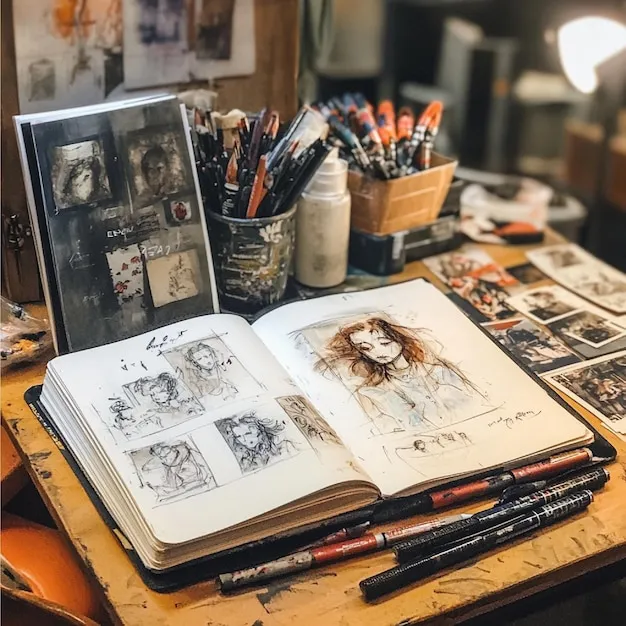
Photo: artist reviewing old sketchbooks and journals creative workspace, via img.freepik.com
There's a moment most creators know well. You scroll back through your old posts, your early videos, your first-attempt paintings or half-finished song files, and you cringe so hard your whole body folds in on itself. The instinct is to bury it — to pretend that version of you never existed and keep pushing forward like your career started yesterday.
But a growing wave of creators is doing the exact opposite. They're going back. On purpose. And what they're pulling out of those dusty digital drawers is becoming some of the most compelling, most honest work they've ever made.
The Archive as Raw Material
Think about what a musician does when they sample an old record. They're not being lazy. They're in conversation with history — pulling something from one context, bending it, layering new meaning on top of it, and releasing it into a completely different world. The sample becomes a statement.
That's exactly what a new generation of creators is doing with their own back catalogs. A visual artist revisits a piece she made at 22, repaints it at 31 with everything she's learned about color, composition, and herself. A YouTuber takes a video essay he made five years ago — one he now disagrees with — and responds to it publicly, frame by frame. A poet publishes a collection that includes her teenage drafts alongside the fully realized versions she wrote a decade later, letting readers watch the transformation happen in real time.
The archive stops being an embarrassment. It becomes the raw material.
Growing Up on the Timeline
Here's the thing about being a creator in 2025: your evolution is documented. Every tweet you ever wrote, every look you tried on, every opinion you voiced with total confidence at 19 — it's all still out there, technically findable, technically permanent. That used to feel like a trap. Now some creators are treating it like a gift.
When you revisit your own past work openly, you're doing something radical in an era that rewards consistency and brand coherence above almost everything else. You're saying: I changed. I grew. I'm not the same person who made that. And instead of hoping nobody notices the gap between who you were and who you are now, you're making the gap the whole point.
There's real power in that move. Audiences are hungry for creators who feel like actual humans — people with histories, contradictions, and arcs. Showing your work in this way, including the old, weird, wrong-headed work, builds a kind of trust that manufactured consistency never could.
Reclaiming the Narrative
Some creators aren't just revisiting old work for the sake of growth. They're going back to reclaim something.
Maybe they made content early in their career that pandered to an audience they no longer respect, or adopted an aesthetic to fit into a scene that never quite felt like home. Maybe they told a story about themselves that got picked up and repeated until it became the official version — even though it wasn't fully true. Going back to that material and reshaping it is a way of saying: that wasn't the whole picture, and I'm the one who gets to decide what the picture looks like now.
This is especially resonant for creators from communities that have historically had their narratives defined by outside forces. When you go back into your own archive and rework it on your own terms, you're not just making art. You're exercising authorship over your own story in a way that has real cultural weight.
What Makes It Land (and What Makes It Fall Flat)
Not every "throwback" moment hits the way a creator hopes. There's a difference between genuinely engaging with your past and just mining nostalgia for a quick engagement bump. Audiences can feel the difference almost immediately.
The creators who do this well tend to share a few things in common. First, they're specific. They don't vaguely gesture at "early work" — they pull out exact pieces, explain exactly what they were thinking then, and articulate exactly what's shifted. The more specific the reflection, the more universal it tends to feel.
Second, they're willing to be uncomfortable. The best archive dives aren't curated highlight reels of charming early mistakes. They go to the places that are genuinely awkward — the work that reflects a worldview they've since rejected, the content that got praise they now wish it hadn't, the creative choices that reveal something they'd rather not admit. That discomfort is where the real connection happens.
And third — maybe most importantly — they make it new. The revisit isn't just a museum exhibit. It produces something: a reinterpretation, a response, a remix. The past work and the present work are in active dialogue, and the audience gets to witness the conversation.
The Long Game
There's a practical argument here, too, beyond the artistic and cultural ones. Creators who treat their archives as living resources rather than dead weight are building something with depth — a body of work that rewards longtime followers while still being accessible to newcomers who want to understand the whole story.
In an attention economy that constantly pressures creators to produce more, faster, always chasing the next thing, choosing to go deeper into what already exists is genuinely countercultural. It's a way of saying that what you've made has lasting value, that your creative journey is worth examining, and that the most interesting story isn't always the newest one.
The demo tape you recorded in your bedroom at 17 might be the most interesting raw material you have. The first video you ever uploaded, the early drafts you thought were too rough to share, the work you made before you knew what you were doing — all of it is still there, waiting.
The question is whether you're brave enough to go back and do something with it.