Wrong on Paper, Right in Practice: Why the Most Electric Creative Collabs Defy Every Rule
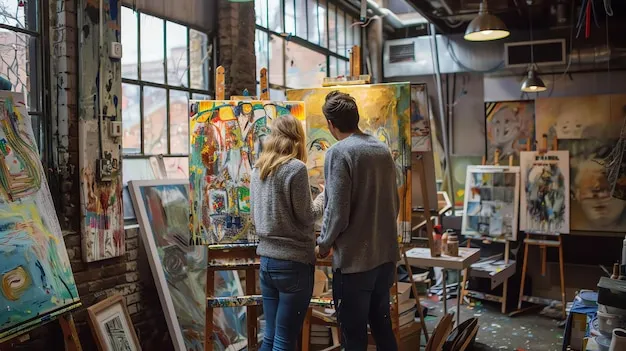
Photo: two artists collaborating in studio with contrasting art styles on wall, via img.freepik.com
There's a version of collaboration that looks great on paper. Same aesthetic, same audience, same general vibe. You've seen it a thousand times — two creators who already feel interchangeable teaming up and producing something that's... fine. Polished. Completely forgettable.
And then there's the other kind.
The kind where a noise musician starts working with a watercolor illustrator. Where a spoken word poet links up with a data visualization designer. Where a Korean American fashion designer who grew up in Atlanta starts co-creating with a Tejano muralist from San Antonio. The kind where everyone in the room is quietly thinking, this might not work — and then it absolutely, undeniably does.
What's going on there? And why does creative friction so often produce better results than creative harmony?
The Comfort Zone Is a Trap (You Already Know This)
Here's the thing nobody wants to admit: seeking out collaborators who think exactly like you isn't just safe — it's a little lazy. When you already agree on references, process, and aesthetic instincts, the work you make together is basically just your solo work with extra steps. You're not really collaborating. You're co-signing.
Real collaboration — the kind that produces something neither person could have made alone — requires actual difference. Not just difference in skill set, but difference in worldview. Different ideas about what art is for. Different gut reactions to the same material. Different definitions of what "done" even means.
That gap between two creative philosophies? That's not a problem to solve. That's the whole point.
When Clash Becomes Chemistry
Take the story of Deja Moreau, a New Orleans-based sound designer known for lush, atmospheric electronic compositions, and Marcus Thill, a Minneapolis illustrator whose work is deliberately sparse — clean lines, limited palette, almost clinical in its restraint. On paper, these two have nothing in common aesthetically. Their first conversation about a potential joint project apparently ended with both of them thinking the other one "didn't get it."
They made the album-and-art-book anyway.
"He kept stripping things back every time I tried to add texture," Deja says. "And I kept pushing back because I thought the emptiness felt cold. But somewhere in that argument, we found this third thing — this space that was neither of our individual instincts. That's the thing that people respond to. Not my version, not his version. The version that came out of the disagreement."
Marcus puts it more bluntly: "If I'd worked with someone who already liked what I liked, I would've made the same book I always make. Working with someone who genuinely challenged my instincts made me better. It also made me a little crazy. But mostly better."
The Science of Creative Dissonance
This isn't just vibes — there's real logic behind why opposing creative forces tend to produce stronger work. When two people share the same assumptions, those assumptions go unexamined. Neither person questions the choices that feel obvious to both of them. But when one person's "obvious" is another person's "wait, why?" — suddenly every decision has to be defended, articulated, and actually thought through.
That process of having to explain your instincts to someone who doesn't share them? It makes you more intentional. It forces you to figure out what you actually believe about your own work, rather than just doing what you always do.
It's the difference between running on autopilot and actually flying the plane.
Finding the Right Kind of Wrong
None of this means you should just grab a random stranger and call it a collab. There's a difference between productive tension and just... incompatibility. The creative partnerships that work across opposing aesthetics tend to share a few key things even when everything else is different.
Mutual respect for craft. You don't have to love what the other person makes. But you do have to genuinely believe they're good at what they do. Skepticism about someone's work ethic or skill level creates a different kind of friction — the bad kind.
Shared curiosity. The best cross-genre collaborators are people who are genuinely interested in what they don't understand. If you're dismissive of the other person's world, you're not going to learn anything from being in tension with it.
Tolerance for ambiguity. The middle space — where your aesthetic and theirs haven't resolved yet — is uncomfortable. Creators who need to know what the project is before they start making it will struggle here. The ones who can sit with not-knowing long enough for something new to emerge? Those are your people.
The Creative Ego Problem
Here's the real obstacle, though. Collaborating with someone whose instincts oppose yours means regularly hearing that your instincts are wrong. Or at least, not automatically right. For a lot of creators — especially ones who've built an audience around a very specific aesthetic identity — that's a hard thing to sit with.
Yvonne Castillo, a Chicago-based textile artist who recently co-designed a capsule collection with a digital glitch artist named Soren Park, describes the process as "genuinely humbling in a way I wasn't prepared for."
"I've been doing this for twelve years," she says. "I have a point of view. I know what I'm doing. And then you work with someone who comes from a completely different tradition and they look at what you're doing and they have questions. Real questions, not polite ones. And you realize that what felt like confidence was actually just familiarity. That's a weird thing to discover about yourself at this stage."
The collection sold out in three days. Yvonne is already planning the next one.
The Takeaway (Or the Challenge, Really)
If you're a creator who's been circling the same collaborator pool — people who already follow you, already get your references, already share your general aesthetic sensibility — this is your invitation to look somewhere else.
Find the person whose work you respect but don't fully understand. Reach out to the creator whose process makes you a little uncomfortable. Propose a project with someone whose instincts are different enough from yours that the outcome is genuinely uncertain.
It might not work. That's part of the deal.
But if it does? You might make the best thing you've ever put your name on — and it'll be something you never could have gotten to alone, no matter how long you waited for the right version of yourself to show up.
The magic isn't in the harmony. It's in the friction. Lean into it.