Neither and Both: The Creators Who Are Building Culture From Scratch
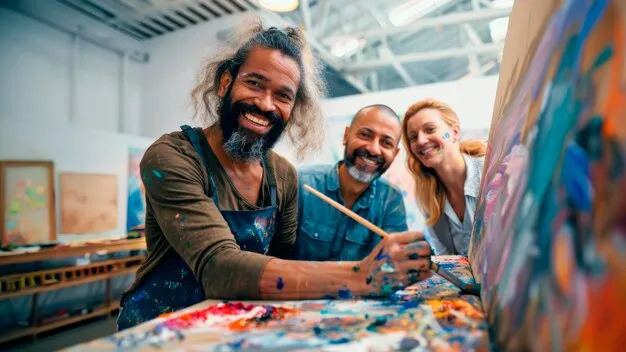
Photo: mixed heritage young artist creating in studio surrounded by multicultural art and objects, via img.freepik.com
There's a question that follows a lot of mixed-heritage kids through their entire lives: What are you? It's usually meant innocently. But it carries weight, because embedded in it is an assumption — that you must be something recognizable, something that fits a known category, something that can be filed away neatly.
For a certain generation of creators, that question has become the raw material for an entirely different kind of answer. Not a declaration of belonging, but an act of invention.
Across music, visual art, fashion, film, writing, and digital content, a wave of mixed-heritage creators in the United States is doing something that goes well beyond representation. They're not asking to be seen within existing cultural frameworks. They're building new ones — aesthetic languages, narrative traditions, and creative vocabularies that reflect the specific, unrepeatable texture of their own intersecting backgrounds. The result is a body of work that doesn't fit neatly into any existing box, because it was never meant to.
The Limits of the Hyphen
For a long time, the cultural conversation around mixed-heritage identity leaned heavily on the hyphen. You were Korean-American, or Afro-Latinx, or Filipino-Irish — the dash a kind of bridge between two shores, each one solid and distinct. That framing was useful, especially as a political and social tool for asserting visibility. But it also implied that the identities on either side of the hyphen were fixed things, and that the mixed person's job was to navigate between them.
A lot of creators will tell you that's not actually what their experience feels like. The reality is less like standing between two countries and more like inhabiting a third place that doesn't have a name yet. The cultural inheritances aren't separate tracks running in parallel — they're fused, distorted by each other, producing combinations and contradictions that neither parent culture would fully recognize.
That third place is where the most interesting work is happening.
Synthesis as Creative Method
What does it actually look like when a creator treats their mixed identity as raw material rather than biographical footnote? It looks like a lot of different things, depending on the specific combination of influences and the medium in which they're working.
In music, it might mean building production that layers sampling techniques from hip-hop with melodic structures from Southeast Asian folk traditions, or fusing the rhythmic vocabulary of West African music with the lyrical cadences of Southern American storytelling. Not as a gimmick or a fusion experiment, but as a natural expression of how the creator actually hears the world. The result isn't a genre you can name. It's something that requires a new set of ears.
In visual art and fashion, it might look like an aesthetic that draws simultaneously on, say, Japanese minimalism and Chicano street art — not to comment on either tradition, but to operate from a sensibility that has genuinely absorbed both. The visual grammar is new. The references are there if you know where to look, but the language being spoken is original.
In writing and storytelling, it might mean building narrative structures that don't follow Western three-act conventions or Eastern cyclical forms, but something in between — or something orthogonal to both entirely. Characters who hold contradictions without resolving them. Stories that move according to a different internal logic.
The Refusal to Translate
One of the most striking things about this generation of creators is their refusal to make their work more legible to any single cultural audience. Earlier generations of mixed-heritage artists often felt pressure to explain themselves — to provide context, to translate, to make sure everyone could find a foothold. That impulse came from a real place, and it produced important work. But it also meant that the artist was always, in some sense, serving the audience's comfort rather than their own vision.
The newer approach is different. It assumes that the audience can rise to meet the work, rather than the work descending to meet the audience. There's an inherent confidence in that — a willingness to let some people be confused, to let the work be genuinely untranslatable, because that untranslatability is itself part of the truth being told.
This doesn't mean the work is inaccessible. Often it's the opposite. Because when something is made from a place of genuine specificity — when it's not trying to appeal to everyone — it often connects more deeply with the people it does reach. Specificity, paradoxically, is what creates universality.
American, but Make It Strange
There's something worth naming here about what this means for American culture more broadly. The United States has always been a place where cultures collide, mix, and produce new things. That's not a new story. But the rate at which that mixing is happening, and the degree to which the resulting combinations are being consciously claimed and explored, feels genuinely new.
The mixed-heritage creators doing this work are, in a real sense, making American culture more honest about what it's always been — a place of synthesis, collision, and reinvention. The difference is that where previous generations often felt pressure to assimilate toward a dominant cultural center, this generation is using the margins as a launching pad. They're not asking permission to exist in the mainstream. They're building something else entirely and inviting the mainstream to catch up.
That's a meaningful shift. It changes what we mean when we talk about American creativity. It expands the definition of what counts as a tradition worth continuing, a reference worth citing, a beauty standard worth aspiring to.
The New Lexicon
What this generation is building, piece by piece, is a new lexicon — a collection of forms, sounds, images, and stories that didn't exist before and couldn't have come from anywhere else. Each individual creator's work is a kind of unique dialect in a language that's still being invented.
That's an exciting thing to watch in real time. It's also a reminder that culture has always worked this way — through collision, through the unexpected combinations that happen when people who carry multiple worlds inside them decide to make something. The difference now is that there are more of those people, they have more platforms, and they're more willing than ever to refuse the question What are you? and replace it with something better:
Watch what I make. That's what I am.