Nobody's Gotta Say Yes But You: The Moment Creators Stop Waiting for the Green Light

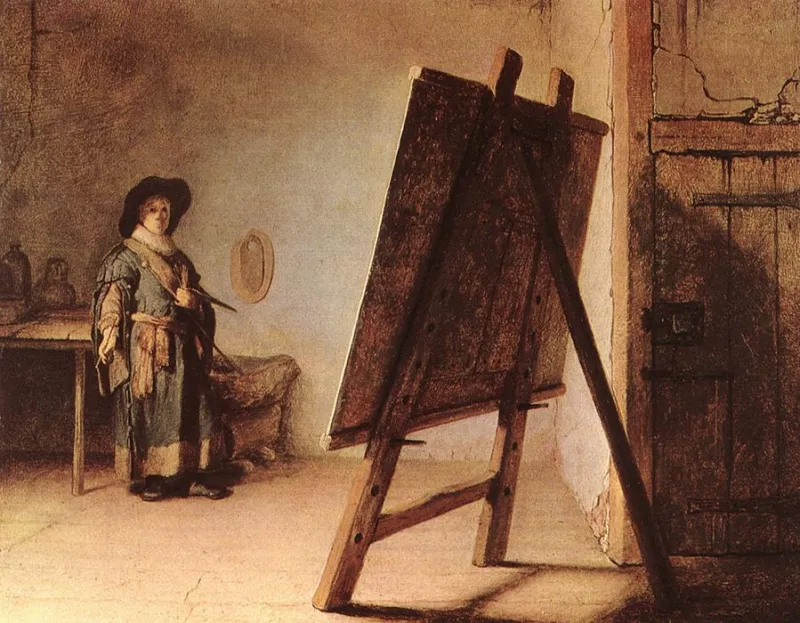
Photo: Unknown artistUnknown artist, Public domain, via Wikimedia Commons
Somewhere between your first post and your hundredth, something sneaky happens. You stop making things because you have to and start making things because you're quietly asking a question: Is this okay? Do you like it? Are we good?
It's almost invisible when it starts. You tweak the caption. You post at the "right" time. You watch the numbers like they owe you something. And slowly, without really noticing, the work stops being yours. It becomes a negotiation — you and the audience, you and the algorithm, you and some imaginary gatekeeper in a corner office who may not even exist anymore.
The creators who actually break through? Most of them will tell you the turning point wasn't a viral moment. It was a quieter, weirder thing: the day they just… stopped asking.
The Approval Loop Is a Feature, Not a Bug
Here's the uncomfortable truth — the platforms are designed to keep you hooked on feedback. Every like, every comment, every share is a small neurological hit that your brain codes as validation. Researchers have compared it to variable-ratio reinforcement, the same psychological mechanism behind slot machines. You don't get rewarded every time, which somehow makes you pull the lever more, not less.
For creators, that loop can quietly colonize the entire creative process. You start pre-editing your ideas based on what you think the audience wants before you've even made anything. You've essentially outsourced your creative instincts to a crowd that hasn't seen the work yet.
Taylor, a visual artist and content creator based in Atlanta who runs a ceramics-focused account with around 80,000 followers, described it this way: "I spent almost a full year making content that performed really well and hating every second of it. I was basically A/B testing my own personality. And the weird part is — it worked. The numbers went up. But I felt completely hollow."
That hollowness is the signal. It means the approval loop has fully taken over.
What Happens When You Pull the Plug
The moment creators describe when they stopped seeking external validation almost always sounds the same: terrifying, then clarifying.
Marcus, a Chicago-based filmmaker and short-form video creator, had built a solid following making polished, trend-adjacent content. One week, almost on a dare to himself, he posted a seven-minute, unedited video of himself just talking through an idea he'd been sitting with — raw, unscripted, kind of awkward. "I genuinely thought it would flop," he said. "I posted it and walked away from my phone for like four hours because I couldn't handle watching it fail in real time."
It didn't flop. It became the most-shared thing he'd ever made. But here's what Marcus says matters more than the metrics: "Even if it had gotten twelve views, something shifted in me. I remembered that I actually had a point of view. That I wasn't just a content machine."
The psychological shift Marcus is describing has a name in creative circles — some call it moving from extrinsic to intrinsic motivation. When you're extrinsically motivated, the reward is external: the likes, the brand deal, the comments. When you flip to intrinsic motivation, the act of making becomes its own reward. The external stuff can still happen, but it's no longer the engine.
Your Weirdness Is the Whole Point
There's a paradox buried in all of this that takes a minute to fully land: the more you try to make something universally appealing, the less interesting it becomes to anyone in particular.
The internet is enormous. Like, genuinely incomprehensibly large. Which means there is a specific audience for almost every specific thing — but only if that thing is actually specific. Vague, crowd-pleasing content dissolves into the noise. Specific, weird, yours content finds its people.
Jade, a New York-based writer and creator who makes content about the intersection of Black American history and contemporary fashion, grew her audience almost entirely by leaning into the niche that she thought was "too niche." "I kept being told to broaden my focus," she said. "Make it more general. More accessible. And I kept thinking, accessible to who? The people who find me because of exactly what I do — they're not casual fans. They're my people."
Jade's following isn't the biggest. But her engagement rate would make most mega-influencers deeply envious. Because she's not performing for a crowd. She's talking to the people who were already looking for exactly what she does.
That's the competitive advantage nobody talks about enough: your specific perspective, your particular obsessions, your cultural reference points — they aren't obstacles to success. They are the success, if you let them be.
The Gatekeepers Got Smaller
Part of what makes this moment genuinely different from previous creative eras is that the old permission structures have largely collapsed. You don't need a record label to release music. You don't need a publisher to reach readers. You don't need a gallery to sell art or a network to build an audience for your show.
Which is liberating, obviously. But it also created a new kind of gatekeeper: the crowd itself. And in some ways, the crowd is harder to shake than the old industry bosses, because it's everywhere, it's constant, and it speaks in the language of numbers you can check at 2 a.m.
The creators who navigate this best seem to understand something important: the audience is a collaborator, not a boss. You can care about what resonates without handing over creative control. You can listen without obeying.
"I read my comments," Marcus says. "I genuinely care what people take away from my work. But I stopped letting comments write my work. There's a difference."
The Permission You Actually Need
So what does it look like, practically, to stop the approval loop? It's not about becoming indifferent to your audience or deciding engagement doesn't matter. It's more about sequence.
Make the thing that's true to your vision first. Let it be complete in itself before it meets the world. Then release it, and let the audience respond to that — the real thing — rather than the pre-compromised, pre-approved, crowd-tested version you might have made instead.
The permission you've been waiting for? It was always yours to give.
The best creators in this universe — and there are a lot of them building something real right now — figured out that the only green light that matters is the one inside the work itself. When it's ready, when it's honest, when it's actually theirs, that's when you post it.
Everything else is just noise you learned to stop listening to.